Arkansas roof insurance claims: the seven-year rule, wind/hail deductibles and how to file
Arkansas roof coverage was rewritten after 2023. Here's what your policy probably says now, what it pays, and how to document a claim so the adjuster can approve it.
What changed
In 2023 Arkansas home insurers paid out $1.71 for every dollar they collected — a 171 percent loss ratio — and three in-state companies shut down, leaving roughly 60,000 homeowners looking for coverage. The survivors rewrote roof coverage across the state. Where policies once paid full replacement cost on a roof for ten, fifteen or twenty years, many now pay it for about seven; after that the roof is depreciated on a schedule, and roofs past twenty years may be covered for actual cash value only. Separate wind/hail deductibles — a percentage of the dwelling coverage rather than a flat amount — became common. The result is that two neighbors with identical hail damage can get very different checks depending on roof age and policy language.
Replacement cost vs. actual cash value
Replacement cost (RCV) pays what it costs to replace the roof today, usually as an initial actual-cash-value payment plus the "recoverable depreciation" released when the work is done. Actual cash value (ACV) pays replacement cost minus depreciation for the roof's age and condition — on a 15-year-old shingle roof that can be half or less, and it's yours to make up. Find the roof section of your policy (or ask your agent) and look for a "roof surfacing payment schedule" or an ACV endorsement; if your roof is older than the schedule allows, know that before you file.
The wind/hail deductible
Your declarations page may show two deductibles: an all-perils deductible ($1,000 or $2,500 is typical) and a separate wind/hail deductible expressed as 1 or 2 percent of Coverage A. On a $350,000 house, 2 percent is $7,000 — which means a $9,000 hail repair nets you $2,000, and a small claim isn't worth filing. Every Northwest Arkansas hail claim starts by reading this line.
What's covered
- Hail and wind damage to the roof — sudden, from a specific storm.
- Trees and limbs on the roof, including removing them from the structure and the interior damage they caused.
- Ice and the weight of ice, including sudden ice-dam interior damage.
- Emergency mitigation — tarping — which insurers expect you to do and will reimburse.
- Code upgrades (ice barrier, drip edge, ventilation the code now requires) if your policy carries ordinance-or-law coverage; many do at 10 percent of Coverage A.
What isn't
- Age, wear, granule loss and cupping from a hot attic — maintenance, not a peril.
- Cosmetic dents on metal roofs, on many policies, and sometimes cosmetic marks on Class 4 shingles.
- Damage from a storm you can't tie to a date — which is why documentation matters.
- Your deductible — never, by anyone, and a contractor who offers to cover it is committing fraud with you.
How to file so it goes through
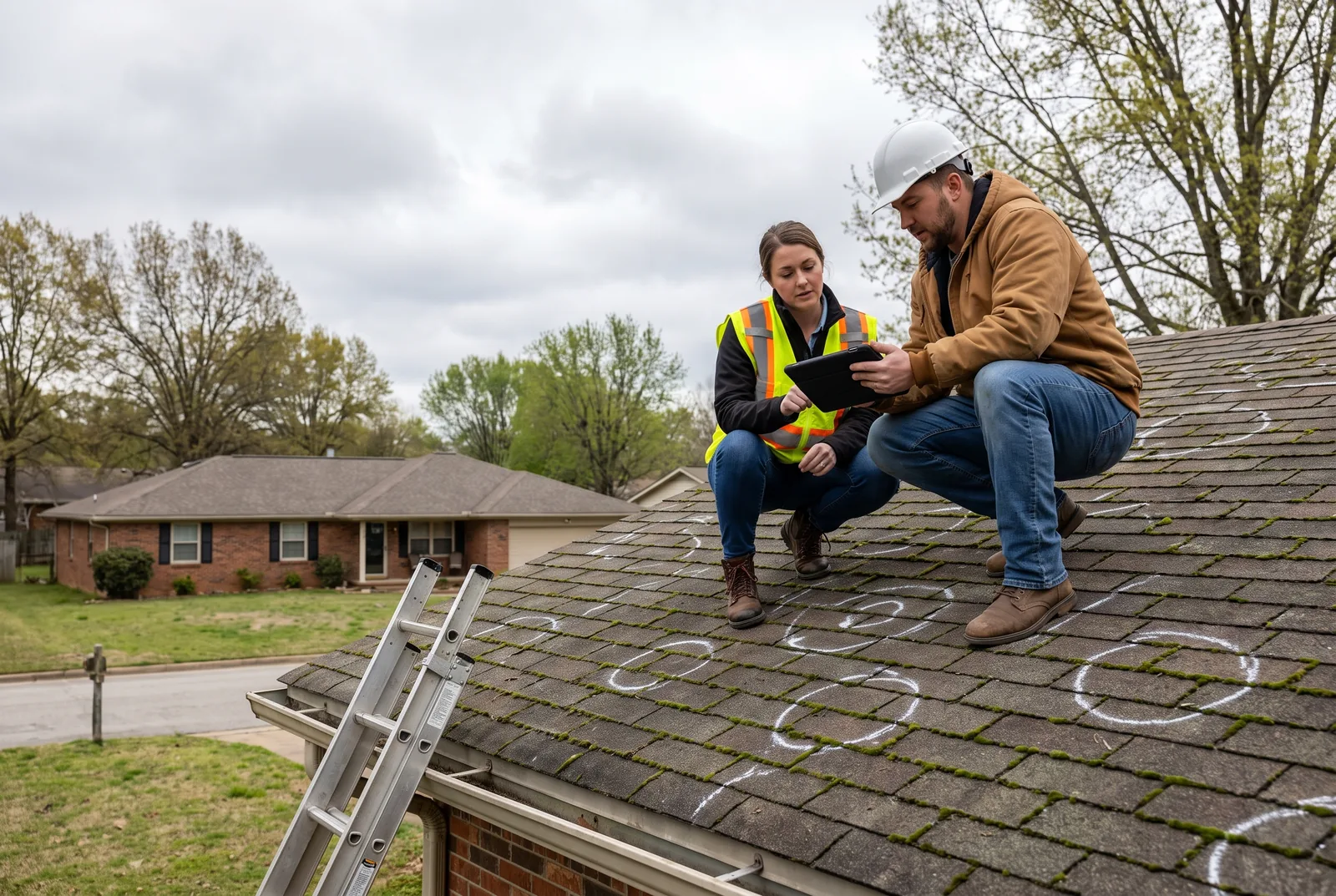
- Get the free inspection first. Photos with dates, test squares on every slope, soft-metal checks, and a radar storm report for your address. You'll know whether it's a claim before you call.
- Read your deductible and roof schedule. If the damage is below the deductible or the roof will be paid at ACV, decide whether filing makes sense — a denied or small claim still goes on your record.
- File with the date of loss. Give the carrier the storm date and the photos.
- Meet the adjuster with your roofer. We walk the squares together; disagreements get settled on the roof, not by mail.
- Build to the approved scope. Supplements for soft decking or code items get documented with photos and submitted properly.
- Collect the depreciation. On an RCV policy, the recoverable depreciation is released when the work is complete and invoiced.
Watch for
Assignment-of-benefits contracts that hand a roofer your claim; "we'll waive your deductible"; estimates written before anyone climbed the roof; and roofers without an Arkansas registration number. After the May 2024 and spring 2025 storms the storm chasers did a lot of damage of their own across Northwest Arkansas.
Common questions
Will my rates go up if I file a hail claim?
A weather claim usually affects rates less than a liability claim, but it counts, and Arkansas carriers are tightening. For a claim near your deductible it's often not worth filing. Ask your agent before you do.
My roof is 12 years old. What will insurance pay?
Depends on your policy's roof schedule. On many post-2023 Arkansas policies a 12-year-old roof is paid at depreciated value — perhaps 40–60 percent of replacement cost — and you cover the rest. Read the roof section or ask your agent; we'll help you interpret it.
Can I upgrade to Class 4 or metal on a claim?
Yes. The carrier pays the approved scope for a like-kind roof; you pay the difference for the upgrade, and the Class 4 or metal discount often follows.
Does the claim cover my gutters and siding?
If hail or wind damaged them, yes — that's why we inspect the whole house, not just the shingles.
What if the adjuster denies the claim?
You can request a re-inspection, submit our photos and storm report, or hire a public adjuster. Many denials are documentation problems, which is why we document before you file.
Related: Roof insurance claims · Hail & storm damage · Insurance & financing · Hail damage guide